
Walk into your raise knowing exactly what your tech DD will say.
Raising, scaling, or adjusting to new regulations? Run tech due diligence on your own terms first. So you know what an investor will find before they look.


Scaleflow


Report
Executive Summary
Architecture
Security
Code quality
Team & delivery
AI Readiness
Roadmap
Verdict
Proceed with confidence
Architecture

Security

Code quality

AI Readiness
Top Findings
312 checks
Scanned 1.2M LOC

Security

Improving
Secrets rotated across 3 services
Adequate

Architecture

Stable
Monolith modularized; clean domain boundaries
Weak

Risk
Improving
Single-point CI dependency — remediation planned
Strong

AI
Declining
Eval pipeline in place, model versioning tracked
Adequate

Code Quality
Improving
Minor code duplication identified; refactoring planned
Strong
Trusted by these teams for full tech due diligence












Clear insight into your product and tech, in one business day.
A read-only scan turns your codebase into a clear, prioritised picture: what’s strong, what to fix, and how you compare to the 300+ companies we’ve X-Rayed.
- 20 minutes
Step 1
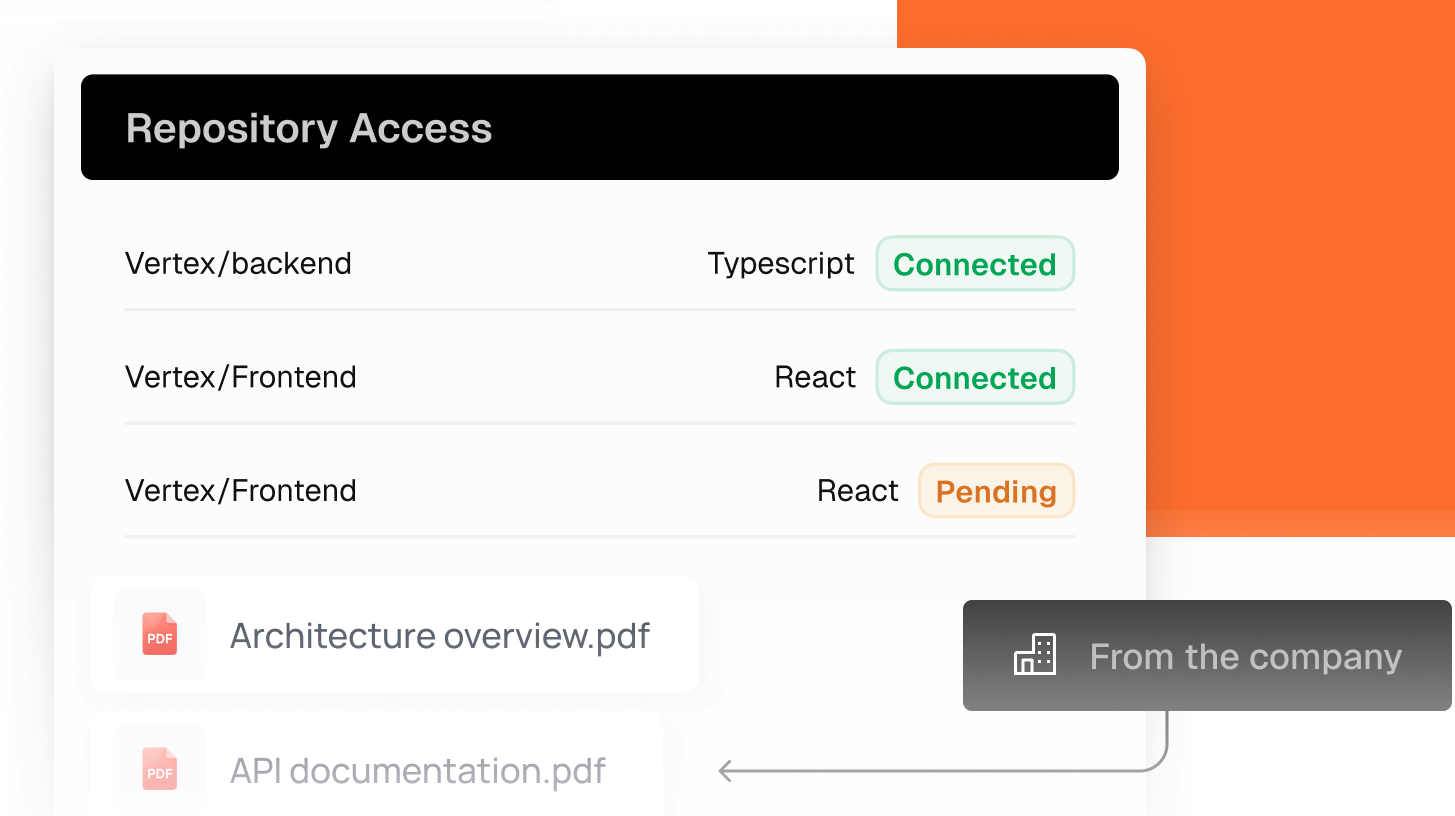
 Connect
Read-only access, under 30 minutes of your team’s time.
- Automated
Step 2
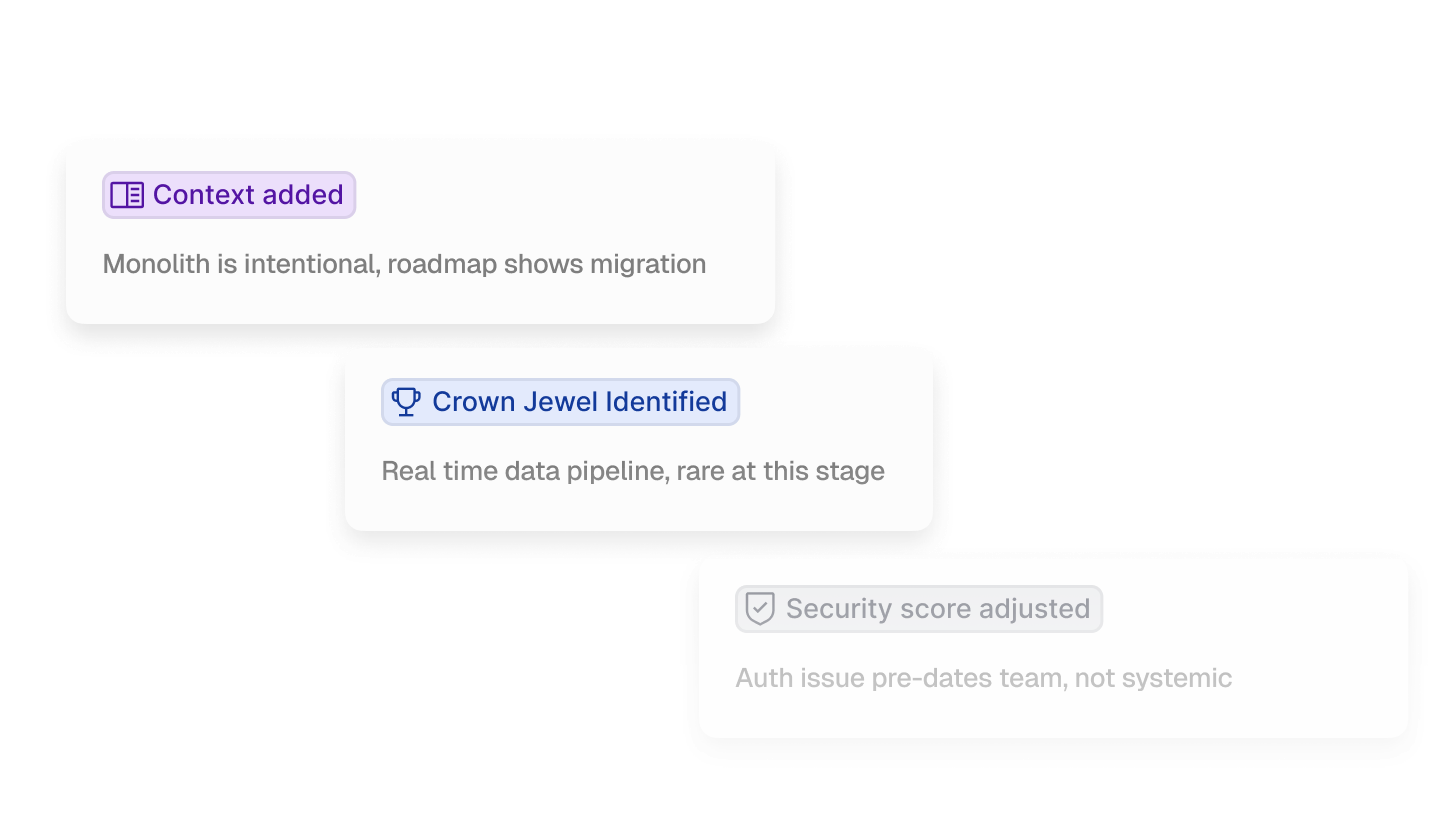
 Protect
NDA signed the same day, with zero data retained.
- Same day
Step 3
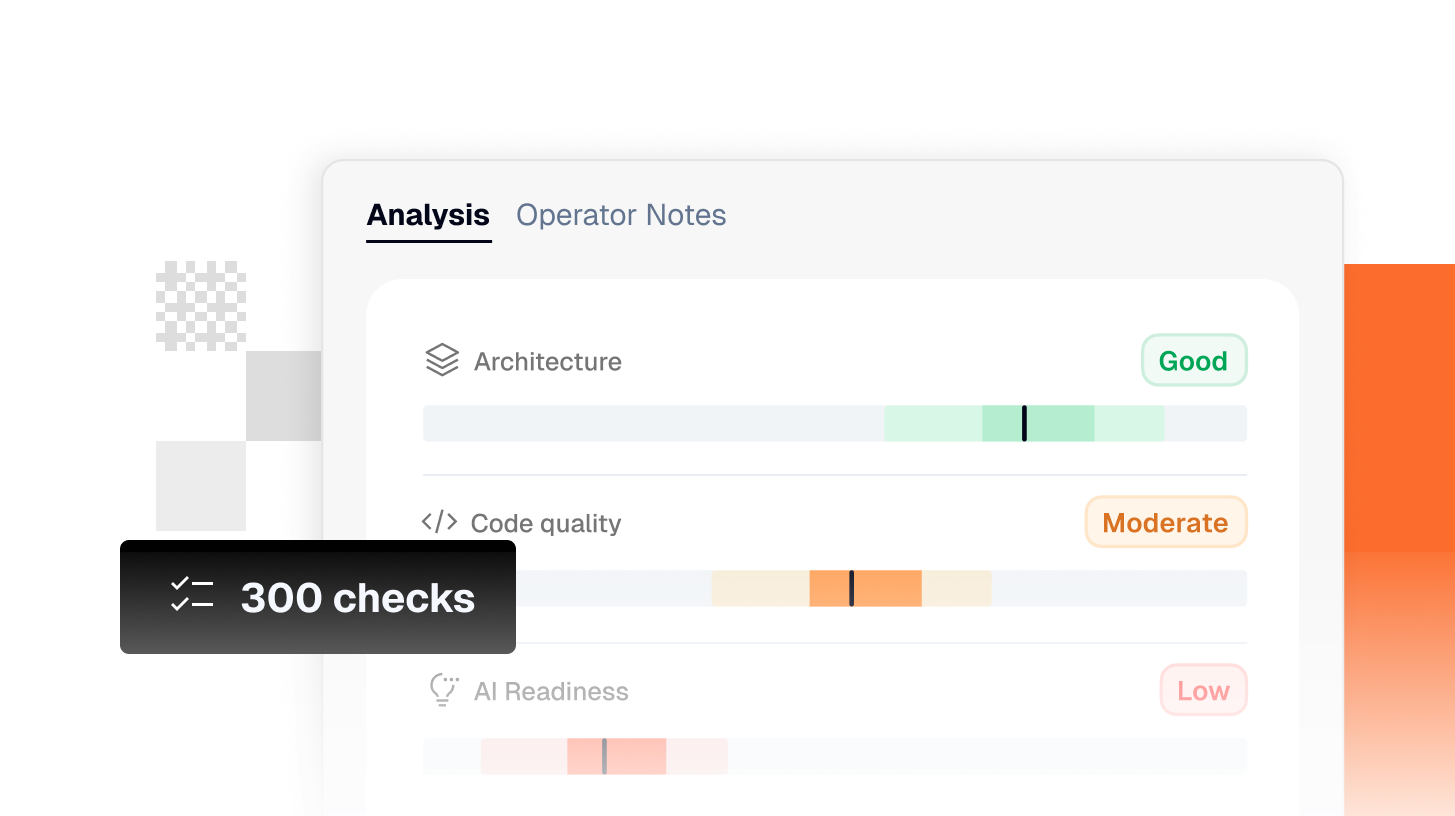
 Verify
300+ checks, operator-verified and benchmarked to your stage.
- 1 Business day
Step 4
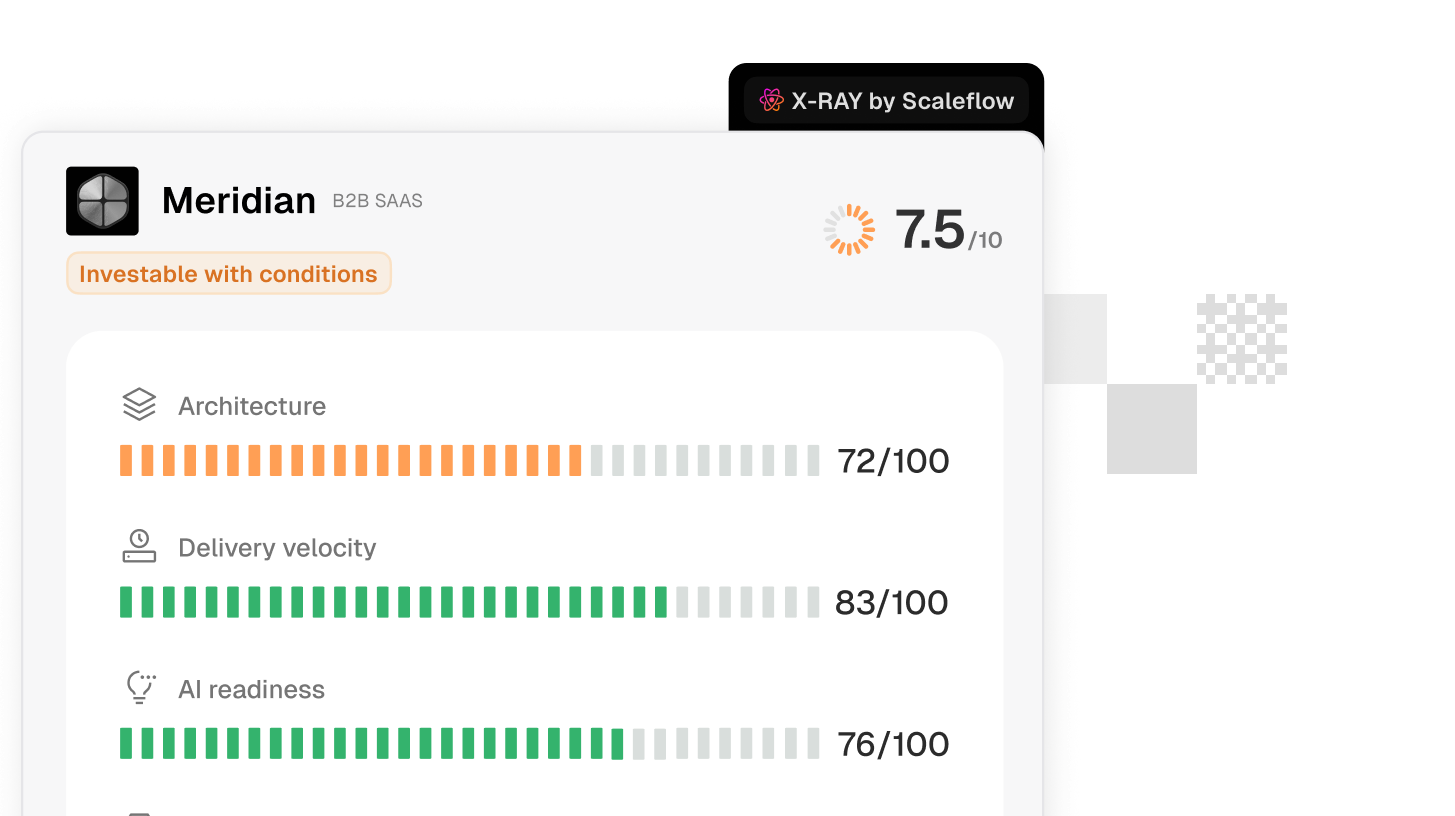
 Act
Three reports for investors, leadership, and your CT(P)O and team.
Three reports, one for every audience.
From your investors to your engineers, everyone reads it in their own language. Download all three from a secure system.
Executive summary
For investors and non-technical readers
The big picture in plain language: what’s strong, what needs work, and the five things that matter most.
- No technical background required
- Five key priorities
- A clear, concise narrative
Technical leadership
For your CT(P)O
Scored areas, architecture and priorities, and security posture — prioritised by impact.
- Benchmarked scores
- Architecture and security posture
- Impact-led priorities
Full findings & actions
For the people who build
Every finding with code references and a clear remediation path, ready for your team to act on.
- 300+ checks in full detail
- Exact file and line references
- Prioritised remediation roadmap
A complete X-Ray of GitLab’s open-source codebase.
Download a sample report
What we assess
Six areas, benchmarked to your stage. Every score is backed by detailed evidence and reviewed by an operator.
Architecture
System design, scalability, data model and infrastructure.
Security & compliance
Vulnerability surface, auth, data privacy and compliance posture.
Code & delivery
Test coverage, CI/CD cadence and tech debt, quantified.
Team & organisation
Key-person risk, engineering culture and hiring gaps.
AI readiness
Real IP versus wrapper, model governance, build versus buy.
Product & strategy
Product-market-fit signals, roadmap quality and commercial alignment.
Beyond the score
- Beyond the score
- Contributor and key-person mapping
- Test coverage across layers
- Delivery velocity over time
- Proprietary IP and non-trivial engineering
- Dependency and CVE exposure
Align your roadmap with your commercial strategy.
A quarter of the average engineering budget builds features that don’t move the business. We map where capacity goes and rebuild the link between what you ship and what it’s worth.
01
Roadmap audit
Map every current roadmap item against commercial goals. Identify what drives revenue and what doesn’t.
02
BON workshop
Map every current roadmap item against commercial goals. Identify what drives revenue and what doesn’t.
03
Stakeholder alignment
Bring product, engineering, sales, and leadership together around agreed priorities.
04
Prioritisation framework
Install a repeatable model balancing revenue impact, effort, and strategic fit.
05
Quarterly planning cadence
Tie quarterly roadmap reviews to commercial KPIs and board reporting.
06
Board-ready reporting
Connect roadmap progress to the metrics investors care about.
Around two to three months, end to end. Scoped to your team and stage.
Instead of hiring more developers, reduce your bottlenecks.
When velocity drops, the instinct is to hire. But adding people to a team with structural friction makes it worse. We find the friction that slows your team down and remove it, structurally.
Seven modules to remove friction and build speed:

Friction mapping
Identify the top bottlenecks: review cycles, deployment pain, unclear ownership, knowledge silos.

Cadence installation
Install the layered operating rhythm so every meeting drives a decision.

Team topology review
Evaluate team structure against product architecture. Fix misalignments that create handoff overhead.

Key-person mitigation
Reduce single points of failure. Spread critical knowledge through pairing, documentation, and rotation.

Velocity metrics
Install meaningful delivery metrics, not vanity numbers. Track throughput, cycle time, and quality over time.

AI opportunities
Identify where AI accelerates your team, from code generation to testing to documentation.

Hands-on coaching
Embed operators with team leads to build and sustain better habits.
Around two to three months, with operators embedded. Scoped to your team and stage.
Your code is treated like it is our own.
Read-only, encrypted, and gone when we’re done, with confirmation in writing at every step.
Your code stays only briefly
It lives in a secure, isolated dataroom for the engagement, encrypted and scoped to this engagement alone.
Read-only and revocable
A full system walkthrough rather than a document review.
Zero storage, confirmed
Nothing is kept or shared. When the dataroom is wiped, you receive written confirmation.

NDA by design
Confidential from the first minute. Our template or yours, signed the same day.



ISO 27001 · SOC 2 Type II · Audits in progress
See how you run, and how you compare.
We have X-Rayed 300+ companies across 11+ verticals, so every area is measured against companies at your stage, in your space.
Built by founders and CTOs who’ve scaled companies before.
The people reading the code are operators: they have built and scaled software companies themselves, and review every finding before it reaches you.

Wilco Van Duinkerken
Founder & CTO

Wouter Neyndorff
Founder & CEO

Jurrie Spoelstra
VP Customer Success

Thijs Jung
Tech Lead EMEA

Indroneel Ray
Tech Lead Asia
What CTOs and founders say about the X-Ray

“I had never experienced a technical due diligence process that required so little time from our team while still producing such a useful assessment.”


“Scaleflow went deep on both our hardware supply chain and the software behind it. A thorough process, and the recommendations were practical, exactly what we needed going into the round.”

“From kick-off to report in two weeks, right when our round needed it. Professional, pragmatic and pleasant to work with.”


“A really helpful outside validation that the direction we’d chosen was the right one. It gave us the confidence to keep building along that path.”

FAQs about technical due diligence for startups
Three ways, from granting temporary access to keeping your code entirely in your own hands. Grant our reviewer read-only access for a short while, the same way you’d onboard an engineer, and revoke it the moment the scan starts. Install a scoped GitHub or GitLab app with read access to only the repositories you choose. Or upload it yourself to a single-use, encrypted bucket. Whichever route you choose, your code runs in a locked-down EU environment, is never executed or read line by line, and nothing is sent to the US.